Request a free consult today!

Are you (or have you been) in a cult?
There is an enormous amount of debate about what constitutes a cult and what groups are or are not cults. The truth is, all groups can be cults but not everyone in that group is in a cult.
DECONSTRUCTIONRELIGIOUS TRAUMA
Robin Thinks!
3/20/20266 min read


What has commonly been referred to in the past as a "cult" has a new, and (in my opinion) much more accurate name. Now, cults are being called "high control groups", which (in my opinion) identifies much more clearly why what we used to call cults are so harmful and dangerous. Today, it is common for brands to embrace the term cult, and brag about building a "cult-like following." The term "cult" also has no real clear definition, and when people think of cults, they often think of only the groups or organizations that have famously caused the greatest and most identifiable harm to individuals, including the loss of life.
What is ironic, is that the harm that all cults/ high control groups cause is the "loss of life", but that doesn't necessarily always mean in the most permanent sense. What you lose is your autonomy, the one thing you rightly should have the most control over, which is your own life.
This is why not every person who is in a specific group or organization will be in a cult, even while others in that same group or organization will be. This is why there is so much debate among members or former members of various groups as to whether the group is or is not a cult. So how is it possible for two people to be a part of a single group or organization and one be in a cult and the other not? Because cults are compartmentalized. The deeper you go or the higher you climb (depending on how you envision it) the more cultish your experience will be, because the deeper you go or the higher you climb, the more personal autonomy you give up.
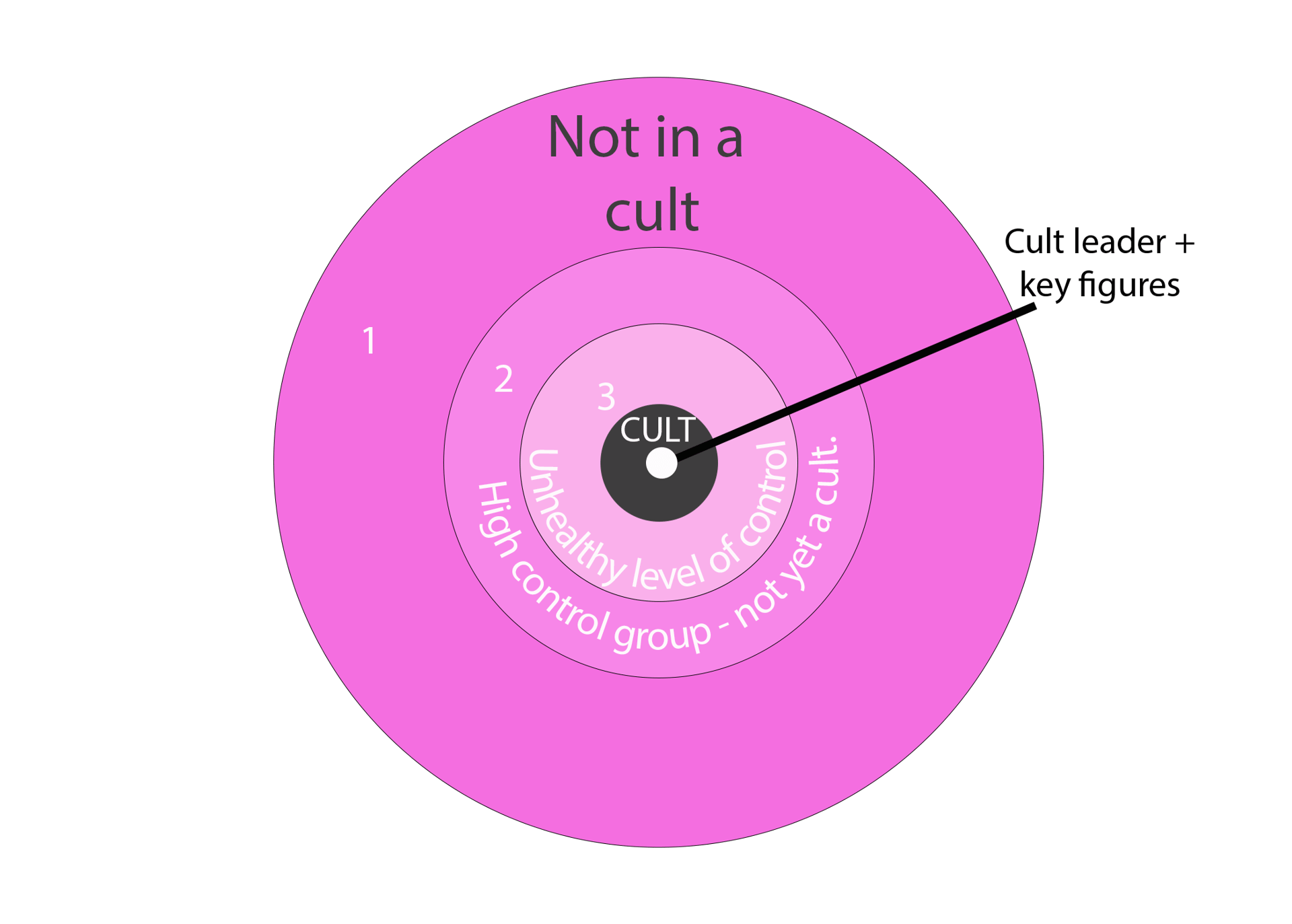
If you picture a cult as a circle, then you can see that the deeper you go towards the center, the higher the level of control. The higher the level of control (pressure to conform to group norms), the more personal autonomy or control you give up. The deeper you drift towards the center, the more likely you are to be in a cult, while someone still on the outer edges of the group is not.
If you imagine the white space around the circle as being the "outside world," then you can see that the deeper you go towards the center of the circle, the more and more cut off you become from the outside world, and the more homogenous the thoughts, ideas and information you are exposed to will be.
Also notice that the largest circle represents the majority of people in any group or organization. This group will only ever be minimally involved and therefore never move into the deepest "inner circles" where the levels of control increase. While this group may have a high degree of involvement in the organization, they will also maintain strong ties to the "outside world", which will keep them from being sucked into the center.
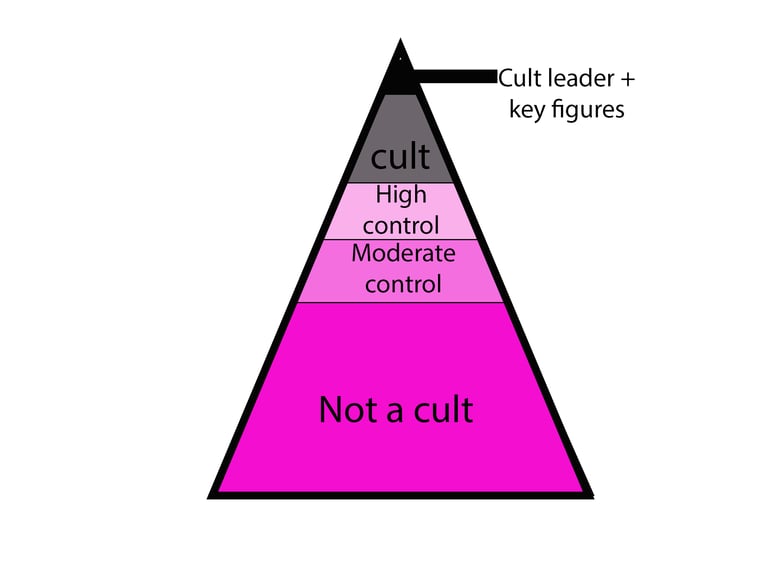
For some people, it can be more helpful to think of cults/ high control groups in terms of a pyramid, such as in a multi-level marketing (MLM) "pyramid" scheme. In this case, the closer you get to the top, the higher the degree of control and the less personal autonomy you have.
One clue to cult/ high control organizational involvement is homogeneity. We all know (or should by now) that diversity is critical for healthy organisms and organizations. Homogeneity is the exact opposite of diversity. The more group members begin to walk, talk, look and sound like each other, the more homogenous they are. One thing you will notice about high control groups is that they have their own "codes" that separate them from outsiders.
This can include either a formal or informal "dress code" or even language peppered with "insider" terminology. If you've ever talked to someone about a group they are a part of and it suddenly felt like they were speaking a foreign language, that is a pretty strong red flag for high control groups. If you find it difficult to talk to people outside of your group because you don't seem to speak the same language or they "just don't understand" the things you do, there is a good chance you are in a high control group.


Although it may be common for families to dress alike for photos, years of books, shows and movies about the Duggar family shows a high degree of homogeneity in the way they walk, talk, act, dress and the worldview they hold.
While things are not always as they seem, and it is never possible to concretely and accurately diagnose situations from the outside, there is and has always been ample evidence that the Duggar family is strongly representative of an extremely high control environment.
The reason this is important to understand is two-fold. The first is that the way you keep yourself from being sucked into a cult (high control group) is to follow the famous investing advice to "never put all your eggs in one basket." One of the most common realizations of women who have come out of abusive or high control relationships is how their abuser systematically cut them off from the outside world. Their abuser will often encourage their victim/ "partner" to quit their jobs, distance themselves from family and friends and create an "us/them" mentality. This is the same tactic that is used in high control groups/ "cults."
The second reason this is important to understand is because you can't evaluate whether a group is a "cult" (high control organization) or not, or the damage it may be causing others, simply based on your own experiences. A famous example of this is Catherine and India Oxenberg, who were both involved to varying degrees with the high-profile NXIVM cult. Catherine Oxenberg actually took her daughter to her first NXIVM meeting, after which, Catherine moved on to other things, while India became more deeply involved.
What was revealed later was that India was purposefully targeted by cult leader Keith Raneire. One of the first things he and his closest acolytes did was to try and sever her ties to her mother, her family and the outside world. This is also why it is possible for almost any church or organization to be a "cult" (high control organization) but it is also possible for two very closely connected people, both of whom are involved in the same organization, to have very different experiences.


While there is obviously a great deal of debate about what constitutes a cult and whether certain groups are or are not cults, I think the one thing that all of those debates miss, however, is what is the harm being caused? In terms of what defines a cult, I think Danielle Mestyanek Young, author of The Culting of America (paid link), offers the best and most comprehensive list of what makes a group or organization a cult.
That being said, it's important to remember that just because a group or organization may be a cult, does not mean everyone in that group is part of a cult. Again, it all has to do with your own individual degree of involvement or investment. But, if you want to evaluate whether a group you are or were in is a cult or not, this is a pretty good list of qualities to evaluate.
Danielle Mestyanek Young’s definition of a cult:
The charismatic leader (& his skinny white woman)
Adherence to a sacred assumption
The transcendental mission
A strong focus on self-sacrifice
Limits access to outside world
Distinguishable vernacular
Us versus them mentality
Exploits member's labor
High exit costs
Ends justify the means mentality
Connect
Reach out anytime for support or questions
Get blogs, news and updates sent straight to your email!
© 2025. All rights reserved.
Based in Colorado